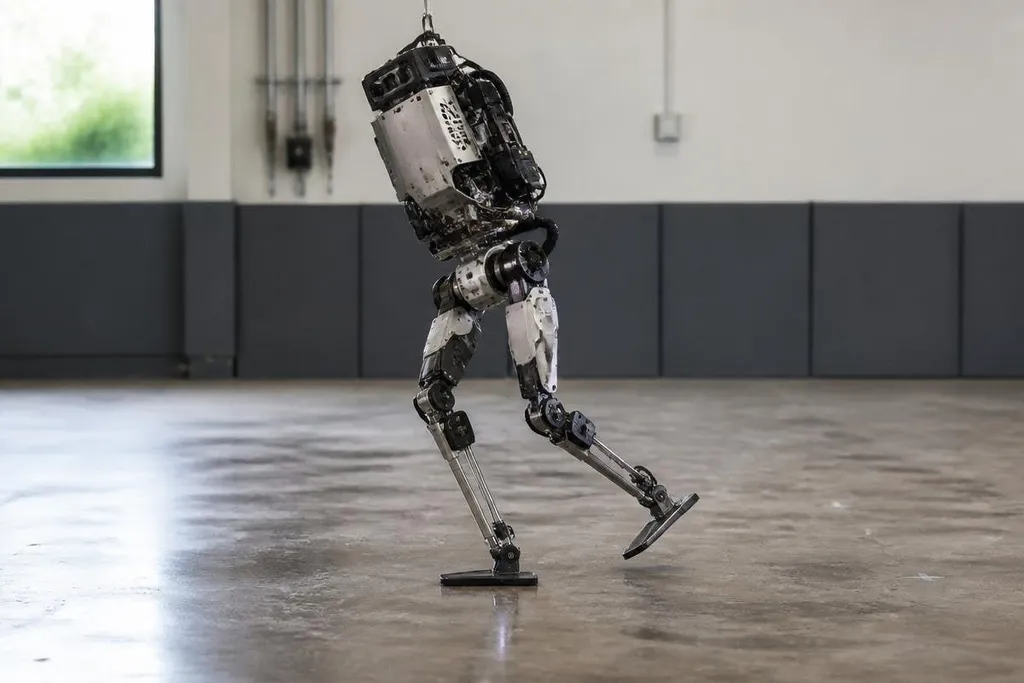
A robot on two legs has to keep moving while its support changes from one foot to the other. Every step shifts its weight, moves its center of mass, and leaves a brief moment when one foot carries the whole robot.
That makes walking a control problem, not a leg problem. The robot must sense its position, predict where its body will move, and place each foot before the fall grows too large.
- Two legs create a narrow support base.
- Sensors must track body motion and contact with the floor.
- Uneven ground exposes limits that a flat demo floor can hide.
Why two legs are unstable
A robot standing still can keep its center of mass above the area between its feet. Walking changes that rule. During a step, the robot lifts one foot and shifts its weight over the other, so the support area becomes much smaller.
The robot then behaves like an inverted pendulum. Its body rises above a moving foot, and small errors can grow as the body moves forward.
A human corrects these errors without thinking about them. The robot has to measure them and send commands to its motors.
The foot also has to meet the floor at the right place and angle. A landing that is a few centimeters away from the planned point can change the load on the ankle, knee, and hip. The controller must respond before the next step begins.
Sensors and control work together
An inertial measurement unit, or IMU, measures changes in the robot’s movement. Joint position sensors report the angles of the legs, while force or torque sensors can show how the foot is pressing against the floor.
The controller combines those readings to estimate the robot’s body position. It then adjusts motor torque, step timing, and foot placement. This loop runs again and again as the robot walks, since the floor and the body never behave exactly as the model predicts.
Many walking systems use the zero moment point, or ZMP, as one check on balance. The ZMP describes where the combined ground forces act under the foot. If that point moves outside the safe support area, the robot must change its posture or place another foot.
Other systems use model predictive control. That method looks ahead over a short part of the next motion, tests possible steps, and selects commands that keep the robot within its balance limits. The calculation has to finish before the robot’s body moves too far.
The control math matters when a biped has to keep its feet under it while doing useful work. Robot24.com's robotics coverage adds named machines and tasks to that comparison before the next section looks at uneven floors.
Why walking surfaces matter
A flat laboratory floor removes many problems. It gives the foot a known surface and lets the controller repeat the same motion. A warehouse floor, construction site, or public walkway adds slopes, gaps, loose objects, and surfaces with different grip.
Those changes affect the force between the foot and the ground. A hard rubber floor can support a planned step in a way that loose gravel cannot. The robot must detect the change, adjust its foot motion, and keep its upper body from moving too far.
Stairs add another demand. The robot has to estimate the height of the next step, lift the foot high enough, and place it without striking the edge. A small error can stop the walk or send the robot into a recovery motion.
Walking is only part of the job
A walking demo can prove that a robot maintains balance for a short task. It doesn't prove that the robot can carry a load, work for a full shift, recover from contact, or stop safely when a sensor fails.
Energy use also matters. Each step moves the robot’s body and repeatedly accelerates its legs. Motors, gearboxes, batteries, and cooling parts add weight, while that weight makes walking harder.
For many indoor jobs, wheels remain easier to control on smooth floors. I'd choose a wheeled base when the work area has level paths and no need to step over obstacles. Two legs earn their space where stairs, gaps, or rough ground make a wheeled base unsuitable.
A practical check before trusting a walking demo
Use these questions when a biped robot moves from a video into a real work plan:
- Surface: Does the test include the floor, slope, or loose material found at the job site?
- Load: Does the robot walk while carrying the required payload, rather than with empty hands?
- Recovery: Can it regain balance after a small push or a missed foot placement?
- Runtime: How long does it walk before the battery, motors, or cooling system limits the task?
- Safety: What does the robot do when its position, force, or balance estimate becomes unreliable?
A two-legged robot is hard to build because walking keeps changing the conditions that must be controlled. The next useful proof is repeated walking on uneven ground with a real load, not one clean pass across a flat floor.